Crypto
The Ethereum Whitepaper by Vitalik Buterin, Explained in Plain English

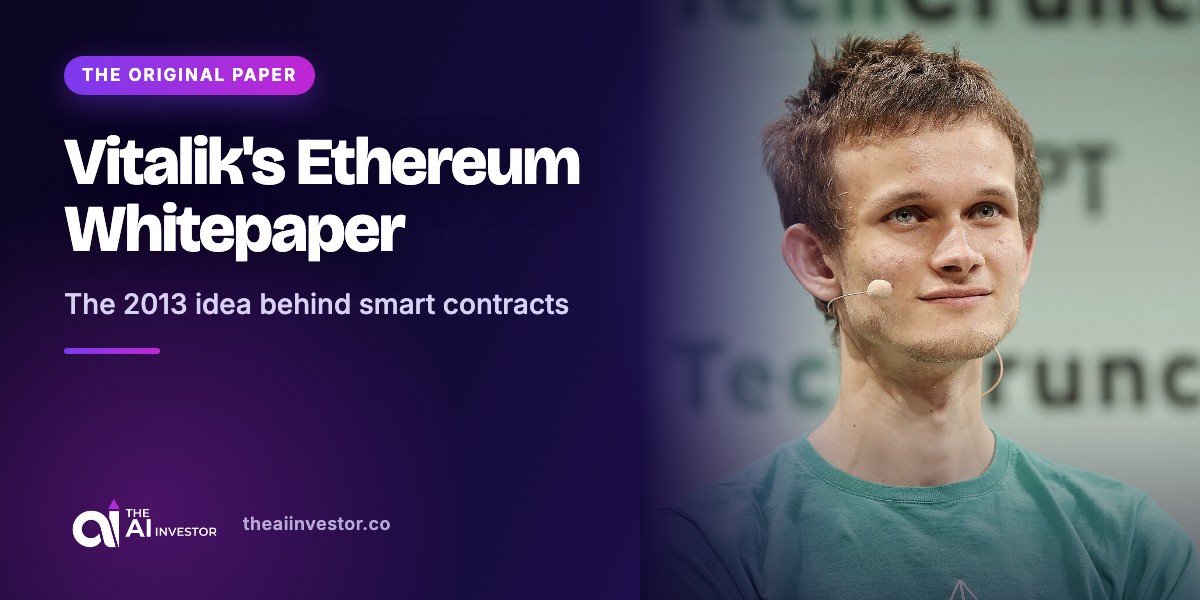
The Ethereum whitepaper, "A Next-Generation Smart Contract and Decentralized Application Platform", was written by Vitalik Buterin in 2013. It proposes a blockchain with a built-in programming language so anyone can create smart contracts and decentralised apps. It is a historical document: Ethereum has since changed, for example by moving from proof of work to proof of stake. Read the official version on ethereum.org.
Read the original
The official whitepaper is kept on ethereum.org: ethereum.org/whitepaper. We link to it instead of copying it, so you always read the version Ethereum's community maintains. ethereum.org notes that the paper is old but remains a useful reference for the original vision.
Author: Vitalik Buterin. Written: 2013, before Ethereum launched in 2015.
Who is Vitalik Buterin?
Vitalik Buterin is a programmer who co-founded Ethereum. Before Ethereum he was involved in Bitcoin communities and co-founded Bitcoin Magazine. In 2013 he published the Ethereum whitepaper, and Ethereum launched in 2015 with a team of co-founders. He remains one of the best-known voices in the Ethereum community, but the network is run by many developers, validators and users, not by one person.
What problem does the paper try to solve?
Bitcoin showed that a blockchain could record payments without a central party. The Ethereum paper asks a bigger question: what if the blockchain could run any program? It proposes a network with a built-in programming language, so people can build many different applications on the same chain instead of creating a new blockchain for each idea.
The main parts, in plain English
- Introduction to Bitcoin and existing concepts. A short history of digital money and why Bitcoin's design is limited for building other applications.
- Ethereum: accounts and transactions. Two kinds of accounts: ones controlled by people with private keys, and contract accounts controlled by code. Transactions can send value and data, and can trigger code.
- Code execution. A virtual machine runs the programs. Every operation costs a small fee, paid in ether, so the network is not overloaded.
- Blockchain and mining. How blocks of transactions are added. The original design used mining (proof of work). Ethereum later changed to proof of stake.
- Applications. Examples such as token systems, financial derivatives and stable-value currencies, identity and reputation systems, decentralised file storage and decentralised organisations.
- Miscellaneous and conclusion. Fees, computation limits and the vision of a platform for decentralised apps.
Five key ideas to remember
- A smart contract is code that runs on the blockchain and follows its rules automatically.
- Ether (ETH) pays for computation and storage on the network.
- Anyone can deploy an app, so the network is a shared platform.
- Fees prevent endless loops and spam.
- Code can have bugs, so contracts need careful checking and audits.
What has changed since 2013?
Ethereum launched in 2015 and has changed a lot. In 2022 it moved from proof of work to proof of stake in an upgrade called the Merge. Layer 2 networks, stablecoins and decentralised finance have grown on top of it. Use the whitepaper to understand the original vision, and use current documentation on ethereum.org for how the network works today. Compare it with Bitcoin in Bitcoin vs Ethereum: a beginner's guide.
How can you read it with AI?

Want to learn this step by step?
Join the free 90-minute live masterclass, every Friday, 7 PM IST (India) or 7 PM ET (everywhere else).
Register for the masterclass nowImportant: This is education only and not financial advice. Crypto is volatile and you can lose all the money you put in.
Image credit: Header photo: Vitalik Buterin by John Phillips, CC BY 2.0, via Wikimedia Commons, cropped and resized. This is the most recent freely licensed portrait we could find.
Frequently asked questions
Who wrote the Ethereum whitepaper?
Vitalik Buterin wrote it in 2013, before Ethereum launched in 2015.
Where can I read the original?
On ethereum.org, which maintains the whitepaper as a reference.
Is the whitepaper still accurate?
It describes the original vision. Some details have changed, such as the move from proof of work to proof of stake in 2022. Use current documentation for how Ethereum works today.
What is a smart contract?
Code on the blockchain that runs automatically when its conditions are met.
Is this financial advice?
No. This is education only.
Namya Aankur Gupta is the founder and CEO of The AI Investor, an education brand that teaches practical AI, investing and crypto skills. Featured by LinkedIn News India as a voice to follow in India. Her content is educational and is not financial advice.