Crypto
The Bitcoin Whitepaper by Satoshi Nakamoto, Explained in Plain English

The Bitcoin whitepaper is a nine-page paper called "Bitcoin: A Peer-to-Peer Electronic Cash System", published by Satoshi Nakamoto in 2008. It proposes digital cash that works without a bank by using digital signatures, a shared public record of transactions (the blockchain) and a competition called proof of work to agree on the order of payments. You can read the official paper below.
Read the original
Download the Bitcoin whitepaper (PDF, 9 pages) or read it on the official site: bitcoin.org/bitcoin.pdf.
Author: Satoshi Nakamoto, a pseudonym. Published: 31 October 2008. The paper is released under the MIT licence, which allows copies to be shared with the licence notice kept. We host a copy for convenience, and the official source is bitcoin.org.
Who is Satoshi Nakamoto?
Satoshi Nakamoto is the name used by the person or group who wrote the Bitcoin whitepaper and built the first version of the software. Their real identity has never been confirmed. They communicated online until around 2010 and then stopped. Many people have been suggested over the years, but none has been proven. What is known comes from the whitepaper, the early code and old forum and email posts, which are public.
What problem does the paper try to solve?
Online payments normally need a trusted third party such as a bank. That adds cost, delays and the risk of reversals. The paper proposes a system where two people can pay each other directly, and the network itself prevents the same coin from being spent twice.
The paper, section by section, in plain English
- Introduction. The problem with trust-based payments and the goal of a system based on cryptographic proof instead.
- Transactions. A coin is a chain of digital signatures. Each owner signs the transfer to the next. The challenge is proving no one spent the coin twice.
- Timestamp server. Transactions are grouped in blocks. Each block includes the previous block's fingerprint (a hash), so changing history would change every later block.
- Proof of work. To add a block, computers must do work that is hard to produce and easy to check. The longest chain with the most work is accepted as the truth.
- Network. The steps nodes follow: broadcast transactions, collect them into blocks, find proof of work, share the block, and accept it if valid.
- Incentive. The first transaction in each block creates new coins for the node that built it, and transaction fees can also be paid. This rewards honest participation.
- Reclaiming disk space. Old transactions can be pruned so the blockchain does not grow too heavy.
- Simplified payment verification. Light users can verify payments without storing the whole chain.
- Combining and splitting value. Payments can have several inputs and outputs, such as sending change back to yourself.
- Privacy. Transactions are public, but names are not attached. Using a new key for each transaction helps privacy.
- Calculations. The maths showing an attacker's chance of catching up falls rapidly as more blocks are added.
- Conclusion. A system for electronic transactions without relying on trust, with the network agreeing on one history through proof of work.
Five key ideas to remember
- No bank in the middle: the network checks payments.
- The blockchain is a shared, append-only record.
- Proof of work makes rewriting history very expensive.
- Miners are paid in new coins and fees to keep the system honest.
- Public keys let you receive payments, and private keys let you spend them. Never share a private key or seed phrase.
What has changed since 2008?
The paper describes the idea. The network has grown and changed in many ways since: mining is now an industry, wallets and exchanges exist, and funds such as Bitcoin ETFs have appeared. The whitepaper is a historical starting point, not a complete guide to how Bitcoin works today.
How can you read it with AI?

Want to learn this step by step?
Join the free 90-minute live masterclass, every Friday, 7 PM IST (India) or 7 PM ET (everywhere else).
Register for the masterclass nowImportant: This is education only and not financial advice. Crypto is volatile and you can lose all the money you put in.
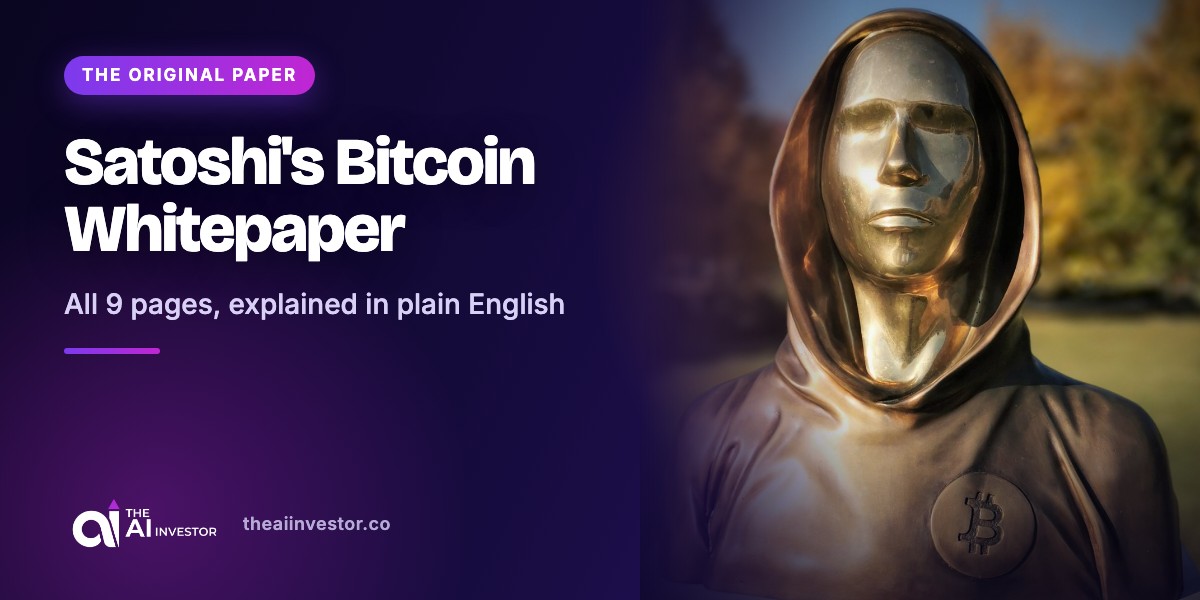
Image credit: Header image: a statue of Satoshi Nakamoto in Budapest, photographed by Elekes Andor, CC BY-SA 4.0, via Wikimedia Commons, cropped and resized. It is an artwork: no verified photograph of Satoshi Nakamoto exists. This header image is shared under the same CC BY-SA 4.0 licence.
Frequently asked questions
Who wrote the Bitcoin whitepaper?
It was published in 2008 under the name Satoshi Nakamoto, a pseudonym. The person or group behind it has not been confirmed.
How long is the Bitcoin whitepaper?
It is nine pages.
Where can I read the original?
On bitcoin.org, and you can also download a copy from this page.
Do I need technical knowledge to understand it?
Some sections use cryptography and maths, but the main ideas are simple. The plain-English notes on this page explain each section.
Is this financial advice?
No. This is education only.
Namya Aankur Gupta is the founder and CEO of The AI Investor, an education brand that teaches practical AI, investing and crypto skills. Featured by LinkedIn News India as a voice to follow in India. Her content is educational and is not financial advice.