Investing
Index Funds vs Active Funds: What the Data Actually Shows

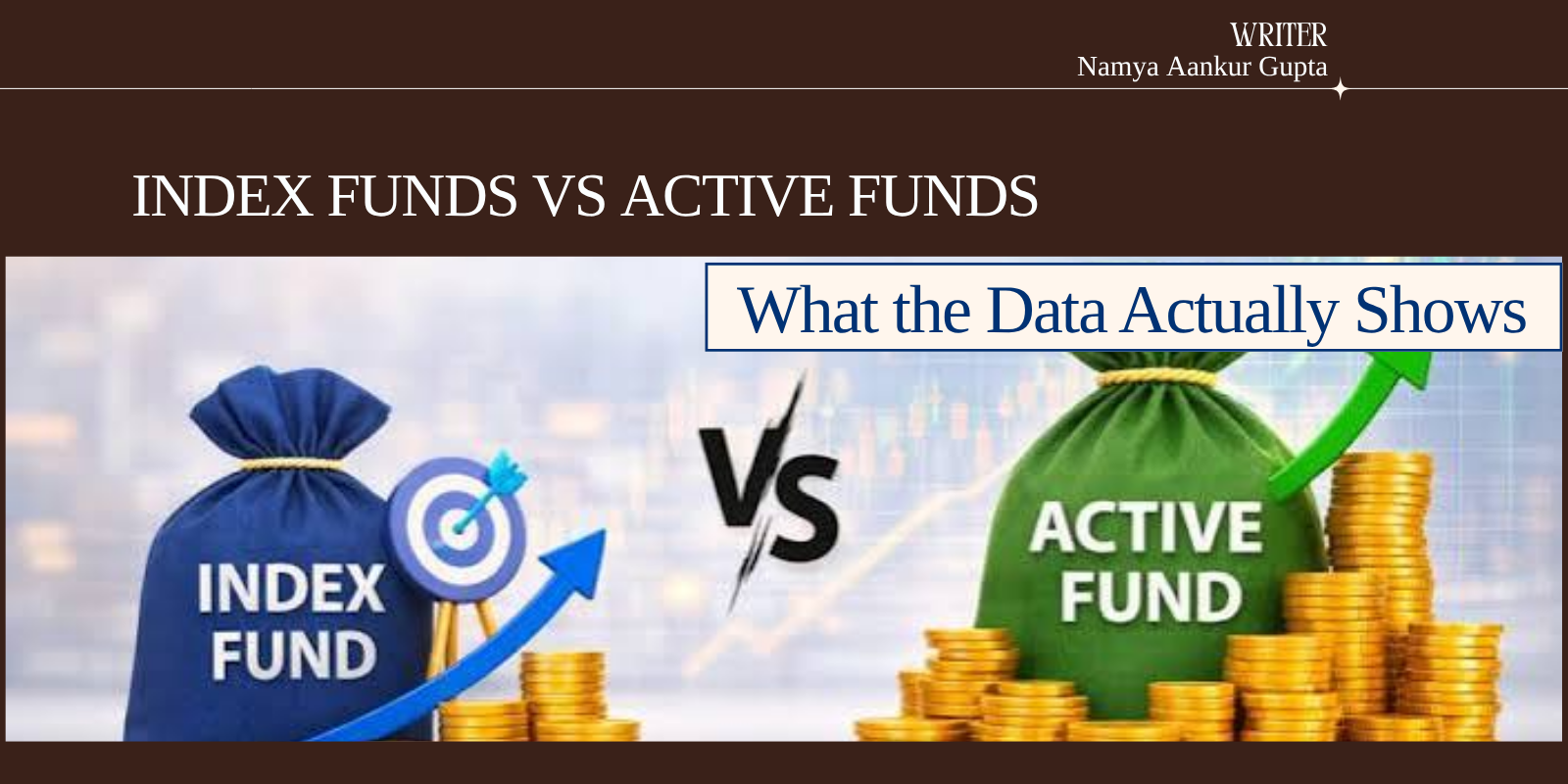
The Debate
The argument for active funds goes like this: skilled fund managers can identify mispriced securities, avoid bad investments, and allocate capital better than a market-cap-weighted index. By paying a higher fee for that skill, investors can earn returns that beat the market and justify the extra cost.
The argument for index funds is simpler: markets are broadly efficient, most active managers cannot consistently identify mispricing, and the fees they charge make it mathematically very difficult to outperform over the long run. A low-cost index fund that simply buys the whole market will beat the majority of active funds over any long enough period.
Both arguments have been debated extensively for decades. The data is now in, and it tells a clear story. The question is whether you are willing to follow where the data points.
What the Data Shows
The S&P SPIVA report (which tracks active fund performance against their benchmark indices) has been published consistently for over 20 years. Its findings are remarkably consistent: over a 15-year period, roughly 90% of active equity funds in most markets underperform their benchmark index after fees. Over shorter periods the numbers are slightly better for active funds, but the longer the time horizon, the worse active funds look relative to their benchmarks.
This finding holds across geographies. It holds for equity funds and bond funds. It holds for large-cap, mid-cap, and small-cap categories. The pattern is consistent enough that it is not a statistical anomaly. It reflects something real about the structural difficulty of consistent outperformance in competitive markets.
The Indian market is sometimes cited as an exception because it is less efficient than the US market, theoretically giving skilled managers more opportunities to add value. The data on Indian active funds is more mixed than the US data, but the trend over longer periods still shows most active funds lagging their benchmarks after costs.
Why Active Funds Underperform
The primary reason is costs. An active fund charging 1.5% to 2% per year in expense ratio starts every year 1.5 to 2 percentage points behind a comparable index fund. To break even with the index, the active manager must outperform by at least that much before fees. To actually beat the index for their investors, they must outperform by even more. Sustaining that margin consistently, year after year, is extremely difficult.
The second reason is that active fund managers are collectively the market. They are not all trading against passive investors who do not know what they are doing. They are mostly trading against each other. In aggregate, active managers cannot outperform the market because they are the market. For every active manager who beats the index, another must underperform by the equivalent amount. After fees, the average active manager must underperform.
The third reason is behavioural: fund managers face career incentives that are not always aligned with long-term performance. Underperforming the benchmark for three years while waiting for a long-term thesis to play out is career-ending even if the thesis eventually proves correct. This structural pressure pushes many active managers toward short-term thinking and benchmark-hugging behaviour that looks active but is not.
The Exceptions
Some active managers do consistently outperform over long periods. Warren Buffett is the most famous example. There are others. The problem is identifying them in advance, before their track record is established. The managers who will outperform over the next 20 years are not necessarily the ones who outperformed over the last 20 years. And picking the right manager in advance requires skill that most investors do not have.
Small-cap markets and less liquid segments of the market are more likely to offer genuine active management opportunities because institutional investors face constraints that create pricing inefficiencies. If you believe active management can add value anywhere, these are the more plausible places to look. But even here the evidence is mixed and the costs are often higher.
What This Means for Your Portfolio
For most investors, the evidence points clearly toward a core portfolio of low-cost index funds or ETFs. This is not a passive or lazy strategy. It is the strategy that the data supports. Getting the market return, minus a tiny expense ratio, puts you in the top quartile of all investors over a long enough period simply because most active alternatives cost more and underperform.
A simple allocation of a broad domestic index fund plus an international index fund plus a bond or debt fund covers most of what a long-term investor needs. You can adjust the weightings to match your timeline and risk tolerance. You can add a gold ETF for further diversification. But the core principle is simple: own the market, pay as little as possible, do not panic during downturns, and let compounding do the work.
The Honest Nuance
The case for index funds does not mean active funds are always wrong for every investor. There are situations where active management makes sense: in illiquid markets where index construction is problematic, in specialised strategies that do not have passive equivalents, or for investors who genuinely enjoy stock picking and treat it partly as an intellectual hobby rather than purely as wealth maximisation.
If you want to allocate a portion of your portfolio to individual stocks or active funds, the evidence suggests keeping it to a small satellite position around a passive core. Something like 80% in low-cost index funds and 20% in higher-conviction individual positions or active funds gives you the mathematical protection of the passive core while preserving the ability to express views on specific opportunities.
The key is being honest about why you are deviating from the index. If it is because you genuinely believe you have identified an edge, that is a defensible reason. If it is because passive investing feels boring or like giving up, that is an emotional reason that is likely to cost you money over time.